Case Study — Construction / Process Design
Miller Commerce
Making a Complex Construction Process Visible — and Millions More Efficient
Made a complex construction project management process visible for the first time — enabling a lean team to establish KPIs and manage multi-million-dollar timelines.
Role
UX Researcher & Process Designer
Company
TAP Developers
Platform
Process Design · Documentation
The Challenge
Miller Commerce develops long-term private communities where every decision is connected to another—and where a missed dependency or a delayed approval can cost hundreds of thousands, or even millions, of dollars. From identifying and acquiring property and conducting geological studies to securing permits, coordinating civil and structural engineering, managing investors and banks, overseeing excavation and construction, and ultimately turning the completed community over to property management, the organization was managing an extraordinary amount of complexity with a remarkably small team. When I was brought into their office, two staff members were visibly overwhelmed and talking in circles about their problems.
Finally, one of them looked at me and said, “Tell us what to do.” I initially pushed back: I wasn't a real estate development expert—how could I tell them what to do? But that question became the starting point. With only two four-hour sessions available for observation and interviews, I went into detective mode, working with staff and leadership to understand how the organization actually operated and uncover the underlying problem before designing a single screen or writing a line of code.
Process & Approach
Rapid Discovery
With only two four-hour blocks available, conducted focused observation and interviews with people across the agency.
End-to-End Process Mapping
Mapped the entire process from project introduction through final General Contractor walkthrough.
KPI & Timeline Framework
Used the complete workflow map to help the team establish KPIs and timelines around each stage.
Actionable Visibility
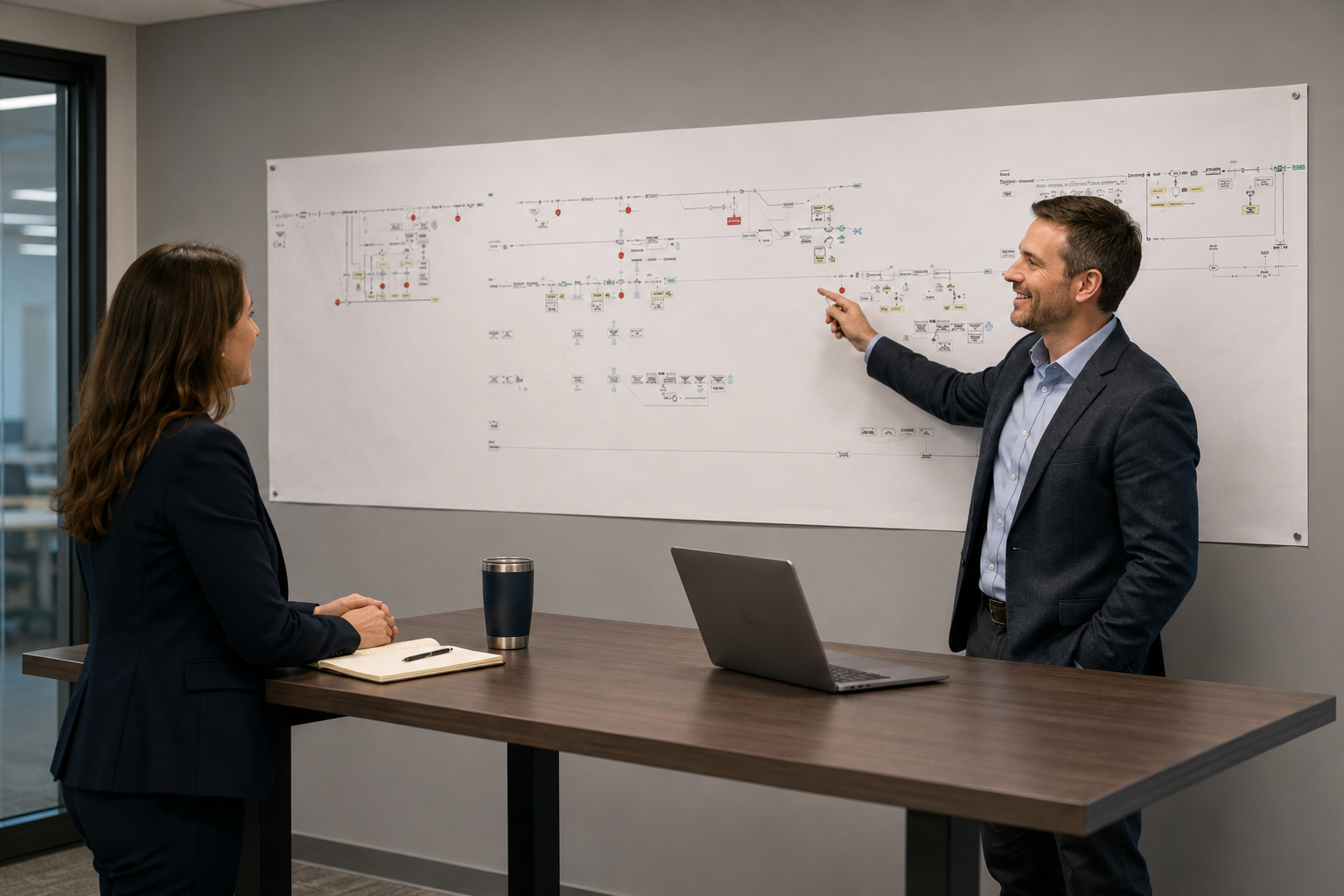
Delivered the workflow as a physical artifact — a 4-by-8-foot document the team could display and reference daily.
Outcomes & Impact
First
Time the team could see their complete workflow in one place
4×8 ft
Workflow displayed in their planning area — still in use
KPIs
Established around each stage of the process for the first time
The solution turned out to be something neither of us initially expected: we never built software. After the two discovery sessions, I invested significant time reconstructing Miller Commerce's entire development process—from the initial idea through acquisition, planning, financing, construction, marketing, and ultimately handing the keys to the property manager. I documented every decision, dependency, parallel workflow, handoff, and potential point of failure, then validated the process with the people responsible for executing it. When I returned to review the completed workflow, the team had printed my diagram on their architectural plotter. A document created with ordinary-sized shapes and 10-point type covered an entire 4-by-8-foot sheet of paper and was hanging beside their conference table. But instead of being overwhelmed by its complexity, they were excited.
For the first time, they could see the entire business they were responsible for managing—what was coming, what depended on what, and where delays could jeopardize millions of dollars. Miller Commerce didn't need me to build them an application; they needed someone to help them see the business clearly. That experience reinforced one of the most important principles of my design practice: before creating a pixel, feature, or line of code, understand the people, understand the workflow, and understand the problem you're actually trying to solve. Sometimes the most valuable product you can deliver is clarity.